Subtotal
$12,403.79
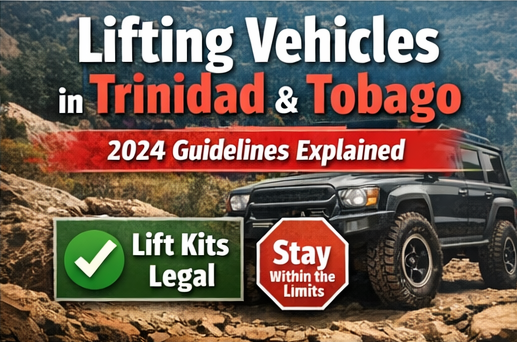
Vehicle lifting has been part of Trinidad and Tobago’s automotive culture for decades. From agricultural work trucks to weekend trail rigs and show vehicles, suspension and body lifts have long been used to improve ground clearance, load handling, and off-road performance.
For years, however, there was major confusion surrounding the legality of lift kits. Many drivers believed lifts were illegal, while others assumed anything went once the vehicle passed inspection. In 2024, the Ministry of Works and Transport (MOWT) officially clarified the situation by releasing formal Guidelines for Lifting Vehicles, bringing long-awaited structure to the modification community.
This article documents those guidelines and explains what they mean for vehicle owners.
The short answer is no — lift kits are not illegal in Trinidad and Tobago.
What is illegal is lifting a vehicle outside of the approved limits or without following the required procedures.
The 2024 guidelines finally created a framework that allows lifting within safe, measurable limits while ensuring vehicles remain roadworthy and safe for public roads.
This was a major step forward for the off-road and automotive community.
The introduction of official lifting guidelines was driven by several concerns:
Previously, inspection results could vary depending on the station or inspector. The new guidelines help remove that uncertainty.
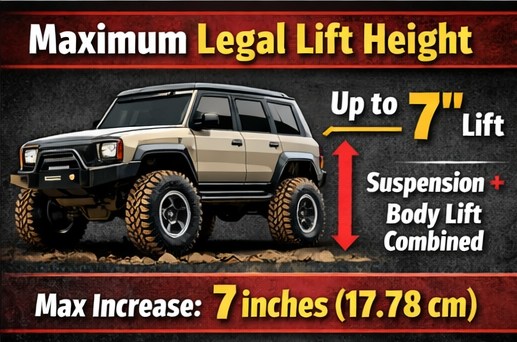
The most important rule introduced:
This total lift includes both suspension lifts and body lifts combined.
This means owners can legally modify their vehicles — but there is a defined safety ceiling.
Not all lift kits are automatically acceptable. The guidelines specify that lifts must use:
This is critical. Homemade or poorly engineered lift setups can compromise braking, steering, and vehicle stability.
The government is essentially saying:
You can lift your vehicle — but it must be done properly and safely.
Modifications often add weight, especially when larger tyres, bumpers, and accessories are installed.
The guidelines state:
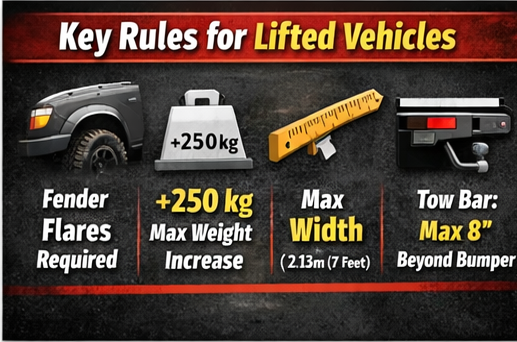
Vehicle tare weight must not increase by more than 250 kg from the original weight.
This ensures:
If the tare weight changes, the owner must update the Licensing Authority.
One of the most common issues with lifted vehicles is tyre protrusion.
The guidelines now clearly state:
This improves pedestrian safety and reduces road debris hazards.
Lifted vehicles often use wider tyres and offsets. The new rule sets a maximum vehicle width:
Maximum width: 2.13 metres (7 feet)
This measurement is taken from the outer edges of the fenders.
This keeps modified vehicles compatible with road lanes and infrastructure.
The guidelines also address common off-road accessories:
Permitted:
Restriction:
This prevents dangerous protrusions during collisions.
Roof racks are allowed but must be declared.
Some modifications require a Notice of Change with the Licensing Authority, including:
This is a simple administrative step but very important for staying compliant.
The 2024 lifting guidelines represent a huge positive step for vehicle enthusiasts.
For the first time, there is:
Instead of banning lifts, the government chose to regulate them responsibly.
This approach supports:
With clear legal limits now in place, proper installation matters more than ever.
A professionally installed lift kit ensures:
A poorly installed lift can cause:
The guidelines encourage safe modification — not shortcuts.
Vehicle lifting in Trinidad and Tobago is no longer a grey area.
Lift kits are legal.
Off-road culture is recognised.
Safety standards are now defined.
The key takeaway is simple:
Lift responsibly. Build safely. Stay within the guidelines.
With the right approach, lifted vehicles can continue to be a proud part of Trinidad and Tobago’s automotive landscape for years to come.